



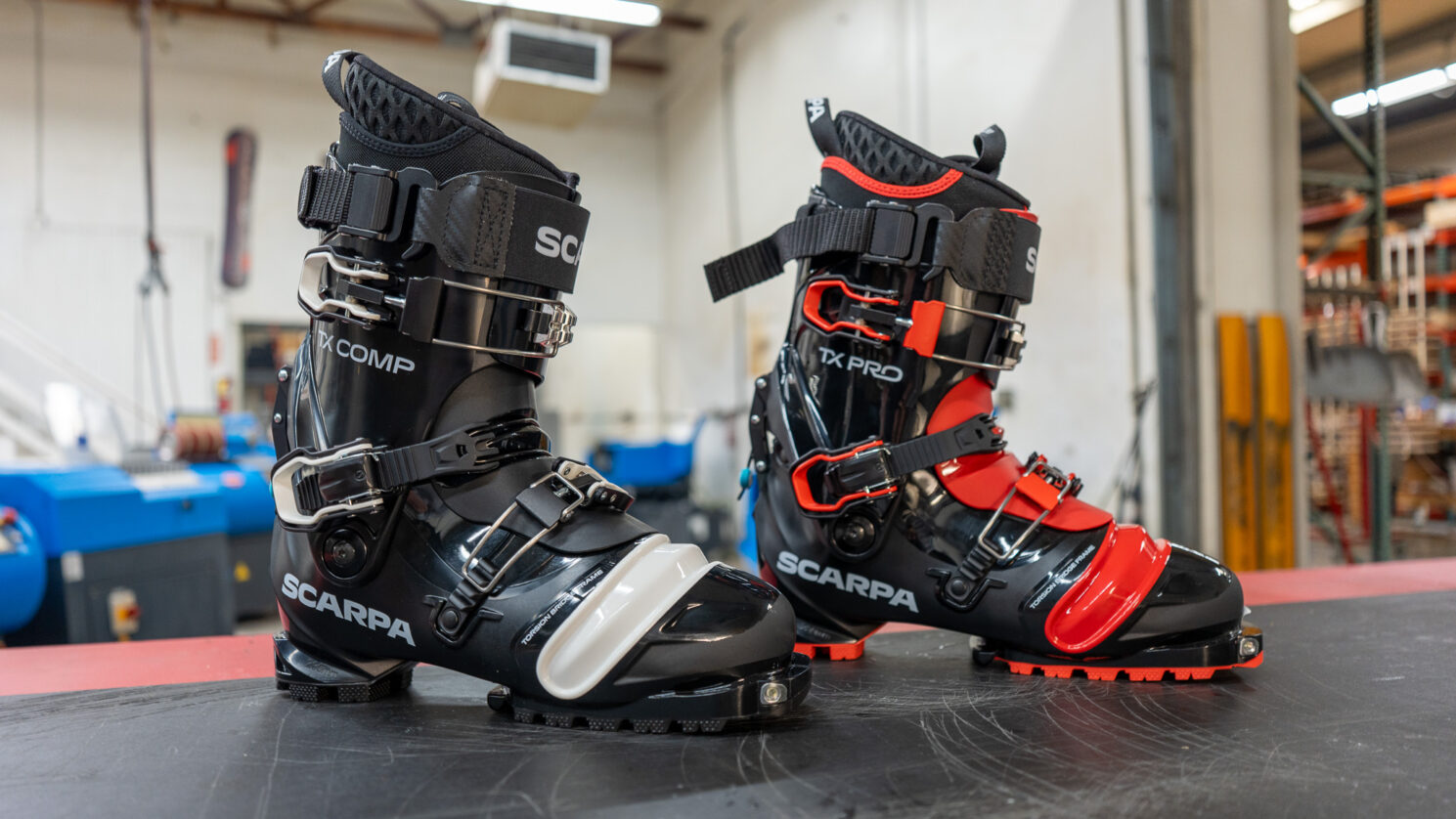
Scarpa TX Pro vs. TX Comp: Which Telemark Boot Is Right for You?
Two high-performance NTN telemark boots, separated by just 13 grams — but the difference in feel matters.
Share this Post
Telemark boot choice is not just about weight. It is about how the boot flexes, how it drives the ski, how it matches your binding setup, and where you spend most of your time skiing.
The Scarpa TX Pro and Scarpa TX Comp are closely related telemark boots, but they are not the same tool. According to Mark Christopherson’s field impressions, the TX Pro is the lighter, slightly softer option that makes a lot of sense for backcountry-focused telemark skiers. The TX Comp is only a little heavier, but it brings a stiffer bellows and cuff that can make a real difference for stronger skiers, wider skis, firmer snow, and resort days.
This is not a winner-takes-all comparison. Both boots have a place.
Scarpa TX Pro: A Backcountry-Focused Telemark Boot
The Scarpa TX Pro is built for telemark skiers who want a boot that tours efficiently but still skis with real performance.
Mark has been skiing the TX Pro for about a season and a half, primarily in the backcountry. Like most telemark boots, the bellows started stiff and softened with use. After a full break-in period, he found the boot to ski very well, especially in soft snow.
In a men’s size 27, Mark weighed the TX Pro at 1538 grams. That makes it a light option for a high-performance telemark boot, especially when paired with its generous walk mode.
Both the TX Pro and TX Comp have a stated 62 degrees of fore/aft range of motion in walk mode. For backcountry touring, that range of motion matters. It helps the boot move more naturally on the skin track, especially on longer approaches or rolling terrain.
The TX Pro has a softer cuff and softer bellows than the TX Comp. Those two features complement each other. In soft snow, that slightly softer feel can be an asset. Mark notes that a softer boot can sometimes help bring the tip of the ski up and keep it riding higher in powder.
That makes the TX Pro a strong choice for telemark skiers who prioritize backcountry efficiency, soft snow performance, and a more forgiving flex.
Scarpa TX Comp: More Power Without Much More Weight
The Scarpa TX Comp adds stiffness without adding much weight.
In the same men’s size 27, Mark weighed the TX Comp at 1551 grams. That is only 13 grams heavier than the TX Pro, but the skiing feel is noticeably different.
The TX Comp has stiffer bellows and a stiffer cuff. Like the TX Pro, those two elements are designed to work together. A stiffer bellows paired with a stiffer cuff gives the boot more support when driving a ski, especially in firmer conditions or at the resort.
That extra support may be especially helpful for bigger skiers, more powerful skiers, or anyone skiing a wider-waisted ski. Wider skis typically require more energy to get on edge, and a stiffer boot can help transfer that energy more effectively.
The TX Comp is not just “the resort boot,” but it does make a lot of sense for skiers who split their time between backcountry and lift-served telemark skiing. If you are roughly a 50/50 backcountry and resort skier, Mark’s recommendation leans toward the TX Comp for the small weight penalty and added power.
Quick Comparison: TX Pro vs. TX Comp
| Boot | Weight, size 27 | Flex Feel | Best Use | Mark’s Take |
|---|---|---|---|---|
| Scarpa TX Pro | 1538 g | Softer cuff and bellows | Backcountry touring, soft snow, powder | Best for skiers prioritizing efficiency and a softer flex |
| Scarpa TX Comp | 1551 g | Stiffer cuff and bellows | Resort skiing, firmer snow, wider skis, more powerful skiers | Best for skiers wanting more support and power for only 13 extra grams |
Which Boot Should You Choose?
The right boot depends less on the spec sheet and more on your actual skiing.
If you are mostly a backcountry skier, the TX Pro is probably the more appealing option. Mark frames it as a strong choice for someone skiing 70–80% backcountry. It is light, tours well, has a softer flex, and feels especially at home in soft snow.
If you split your time more evenly between backcountry and resort skiing, the TX Comp starts to make more sense. For a skier who is around 50% backcountry and 50% resort, the extra stiffness can be worth it. On firmer resort snow, that added support helps drive the ski and gives the boot a more powerful feel.
Ski width also matters. If you regularly ski wider skis, you may appreciate the added leverage of the TX Comp. If your setup is lighter, narrower, and more backcountry-oriented, the TX Pro may be the better match.
Boot Flex, Binding Cartridges, and System Compatibility
Boot choice does not happen in isolation. The boot, binding, cartridge stiffness, and ski all need to work together.
Mark noticed this clearly when testing the TX Comp. When he first skied the TX Comp with a softer backcountry-style cartridge, the boot made the cartridge feel soft. That showed how much power the TX Comp brought to the system.
With the TX Pro, that softer cartridge felt well matched. With the TX Comp, especially at the resort, Mark prefers a stiffer all-mountain cartridge.
That is the bigger lesson: a powerful boot may need a binding setup that can keep up with it.
When choosing between the TX Pro and TX Comp, consider:
- Where you ski most often
- Whether your snow is usually soft or firm
- How aggressively you drive your skis
- How wide your skis are
- Whether your binding/cartridge setup matches the boot’s power
A good telemark setup is a system. The best boot is the one that matches the rest of that system.
Demo If You Can
Fit still matters more than anything.
Both the Scarpa TX Pro and TX Comp are high-performance telemark boots. Both have strong use cases. But no review, comparison, or spec sheet can replace putting the boot on your foot and, ideally, skiing it.
If you are in the Salt Lake City area, Voile demos these boots at the Voile Retail Store. Try them, feel the difference, and choose the boot that fits your skiing style.